
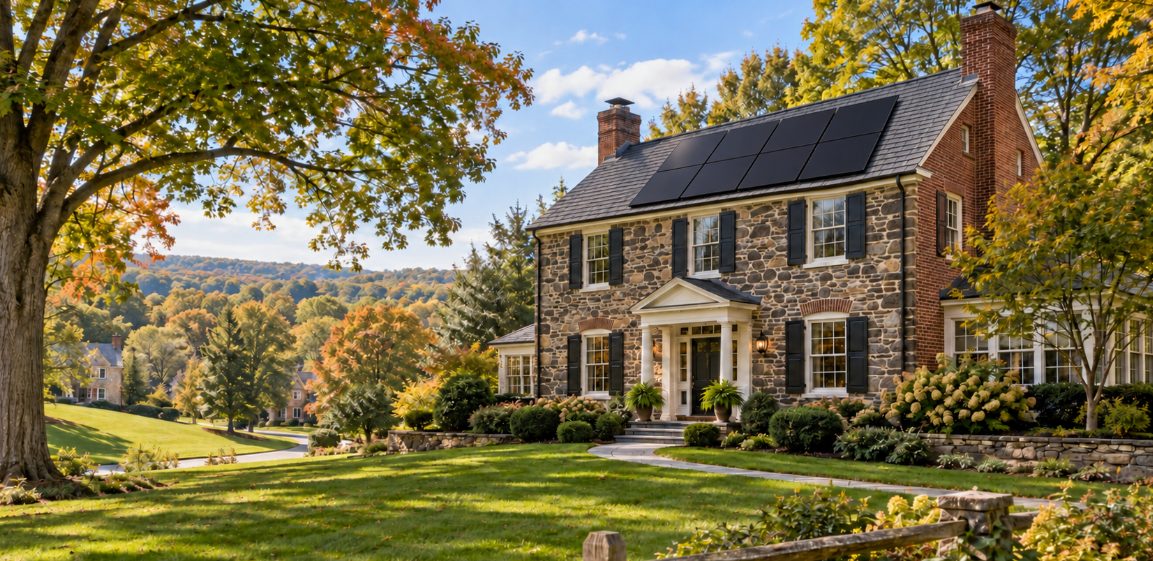
Is solar worth it in Pennsylvania? For many homes, it can be. Pennsylvania offers full-retail net metering, a solar credit market and plenty of household energy demand. But the answer depends on your roof, your utility and how much power you use. This guide walks through each piece.
Some Pennsylvania homeowners assume solar only makes sense in states with endless sunshine. It doesn't.
Solar panels make electricity from sunlight, not heat. A well-designed system can produce real energy through all four of Pennsylvania's seasons.
But that does not mean every Pennsylvania home should install solar.
The better question is
“Does solar make sense for my particular home, utility, roof and energy usage?”
For some homeowners, the answer may be yes.
For others, HVAC, insulation or other efficiency upgrades may deserve attention first.
Can Solar Really Work in Pennsylvania?
Yes.
Pennsylvania already has a large solar market. As of 2025, the state had reached about 2 gigawatts of installed solar. That is enough to cover the power use of hundreds of thousands of homes.
A home system's output will change with the seasons.
Summer usually brings longer days, more solar production and more air conditioning.
Winter brings shorter days, a lower sun, more clouds, some snow and more heating demand in homes with electric heat.
The right way to judge solar is not by looking at one cloudy week.
It is by comparing a full year of solar production with a full year of household electricity use.
What Makes a Pennsylvania Home a Good Solar Candidate?
Solar may be worth a look if your home has:
- Good roof exposure
- Limited shading
- A roof with many good years left
- Meaningful yearly electricity use
- A workable path to connect to the utility grid
- Access to net metering
- Reasonable system pricing
- Plans to stay in the home for several years
Shade and roof condition matter a lot.
Panels on an aging roof may have to be removed and put back when the roof is replaced.
Heavy tree cover can also cut production enough to change whether the project pays off.
The house should be evaluated before the financing paperwork.
Does Pennsylvania Have Net Metering?
Yes.
Net metering means you get bill credit for extra solar power you send to the grid. In Pennsylvania, qualifying home solar systems up to 50 kW can take part.
Pennsylvania DEP currently describes qualifying extra power as credited at the full retail rate, subject to your utility's rules.
That is an important advantage.
When your panels make power, your home uses it first.
If you make more than you use, qualifying extra power can flow back to the grid and earn bill credit.
The exact hookup and billing process still depends on your electric distribution company (your local utility).
Why Full-Retail Net Metering Matters
Suppose your home uses 1 kWh of electricity.
If solar produces that 1 kWh at the same time, you avoid buying it from the grid.
If your system makes extra power, Pennsylvania's current home net-metering rules can credit it at the retail rate for qualifying systems.
That can make power you send back worth more than in states that pay only a wholesale or supply-only credit.
It also means a system should still be sized to your real usage — not just packed with as many panels as possible.
Pennsylvania Electric Choice Adds Another Question
Many Pennsylvania homeowners can choose their electricity generation supplier.
The Pennsylvania Public Utility Commission runs PA Power Switch. It lets eligible customers compare suppliers and rate plans.
So one company may deliver your power while another company supplies it.
Solar homeowners should understand how their supplier works with net metering and billing.
Before signing a solar agreement, know:
- Your electric distribution company
- Your generation supplier
- Your current generation rate
- Your net-metering arrangement
- Any supplier-specific contract terms
What Are Pennsylvania SRECs?
Pennsylvania solar systems may also earn renewable-energy credits.
Pennsylvania's Alternative Energy Portfolio Standards, or AEPS, create demand for qualifying clean power.
Solar projects can earn Solar Renewable Energy Credits, known as SRECs. These are tracked in the PJM Generation Attribute Tracking System, or GATS.
That creates a possible second source of value.
A solar system may provide
electricity savings
and renewable-energy credits. Those are separate.
How Does an SREC Work?
A qualifying solar system earns credits based on how much power it produces.
Those credits can be registered, tracked and possibly sold in the credit market.
Pennsylvania DEP points homeowners to the AEPS program for details on registering a system and selling or transferring credits.
SREC value is not guaranteed.
Prices can change with supply, demand, state clean-energy requirements, rule changes and how many people take part.
So SREC income should improve a good project — not rescue a weak one.
Who Owns the SRECs?
This is an important contract question.
Ask: “Do I own the renewable-energy credits generated by this system?”
Some solar contracts may hand REC ownership to another party.
If the installer, lender or another company owns the SRECs, you may not be able to sell them yourself.
Understand that before you sign.
What Happened to the Federal Solar Tax Credit?
For new home solar placed in service in 2026, do not assume the former 30% Residential Clean Energy Credit is available.
From 2022 through December 31, 2025, the credit applied to qualifying clean-energy property. It is not available for property placed in service after that date.
This matters in Pennsylvania because some state information pages have not been updated yet. They still mention the older federal credit.
For a 2026 project, rely on current federal tax guidance, not an older solar calculator.
Does Pennsylvania Have a Universal State Solar Rebate?
No single statewide cash rebate goes to every home solar owner automatically.
Pennsylvania does offer other energy financing and assistance programs. The state's Energy Accelerator Program has listed homeowner financing such as the KEEP Home Energy Loan. Check current availability and terms before counting on it.
Pennsylvania was also awarded federal Solar for All funding for a low-income home solar program. But the U.S. EPA moved to end the Solar for All grants in August 2025. The program has since faced legal challenges.
Do not count on Solar for All money for a current project. Be skeptical of any installer who claims to be an active Solar for All partner.
That is worth knowing.
HVAC and Efficiency Can Change the Solar Equation
Pennsylvania's own solar guidance recommends looking at home efficiency before installing solar.
That makes sense.
A home may be wasting power because of old air conditioning, aging heat pumps or electric resistance heat. Poor insulation, leaky ducts, air leaks and electric water heating can add to it.
If you cut that usage first, you may need a smaller solar system.
Imagine a house using 17,000 kWh a year. After HVAC and efficiency upgrades, it uses 13,500 kWh.
Sizing solar around the old usage could mean paying for panels the home no longer needs.
What About Pennsylvania Efficiency Programs?
Pennsylvania has a major statewide energy-efficiency framework through Act 129.
Act 129 utility efficiency programs have produced more than 8.8 million MWh of electricity savings since 2009. They have also produced billions of dollars in customer savings.
Depending on your utility and current programs, you may find incentives or rebates for qualifying efficiency upgrades.
That means solar should not be judged on its own.
What About Battery Storage?
A battery solves a different problem.
Solar makes electricity. A battery stores it.
A battery may make sense if you worry about storm outages. It can keep key circuits running, such as sump pumps, refrigerators, well pumps, medical equipment or internet.
But a standard grid-tied solar system does not automatically give you backup power.
If outage protection matters, ask exactly what the proposed system will keep running when the power goes out.
So, Is Solar Worth It in Pennsylvania?
It can be.
Pennsylvania currently offers several helpful ingredients:
- Full-retail net metering for qualifying residential systems
- A working renewable-energy credit market
- Electric-choice flexibility
- Significant household energy demand
- Utility efficiency programs
But solar still has to make sense for the actual house.
Start With the Home
Ashborn Partners helps Pennsylvania homeowners review solar, battery storage, heating and cooling, and whole-home efficiency in one personalized review.
We don't start with the assumption that every homeowner needs panels.
We start with your energy usage and the problem you're trying to solve.
Your home. Your energy. Your options.