
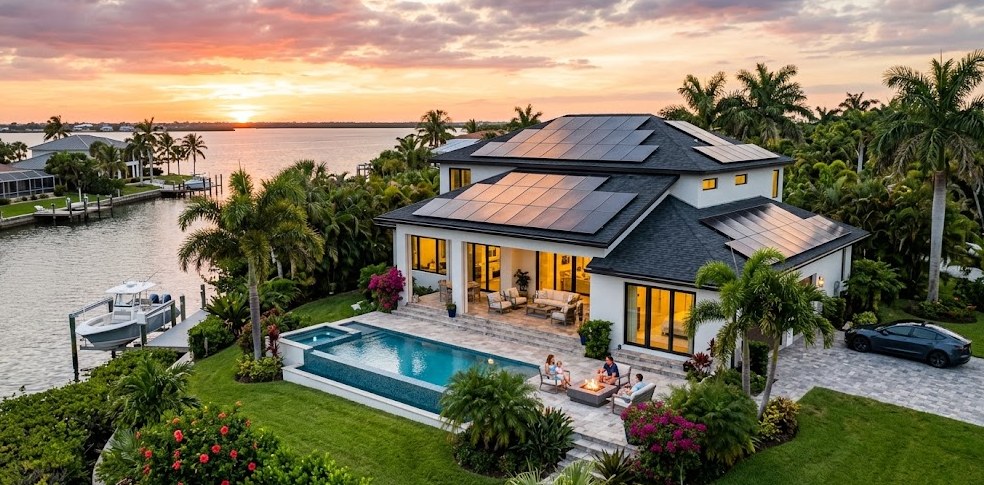
Solar, battery or HVAC: which should a Florida homeowner invest in first? It depends on the problem you're trying to solve. Here's how to decide.
You've got a $300 electric bill.
The air conditioner seems to run nonstop.
You've thought about solar.
Then hurricane season arrives and you start looking at batteries.
Suddenly, three different contractors are offering three different solutions to the same house.
The solar company says you need solar. The HVAC company says you need a new air conditioner. The battery company says you need backup power.
Here's the problem:
They might all be right.
But that doesn't mean you should buy all three — or that they should be installed in that order.
A home is an energy system. Understanding how that system works can help Florida homeowners decide where the next dollar should go.
Start With the Problem You're Trying to Solve
Before comparing products, identify the goal.
Are you trying to:
- Reduce your monthly electricity expense?
- Improve comfort?
- Replace aging equipment before it fails?
- Protect against outages?
- Reduce dependence on utility electricity?
- Make the home more efficient?
- Accomplish several of these at once?
Different technologies solve different problems.
Solar
Generates electricity. Its primary value is reducing the amount of electricity that needs to be purchased from the utility.
HVAC
Consumes electricity. A more efficient system may lower energy consumption while improving comfort, humidity control and reliability.
Battery Storage
Stores electricity. Depending on configuration, it may provide backup power and allow stored energy to be used later.
Solar creates. HVAC consumes. A battery stores.
That is why choosing the right starting point requires understanding the house.
When Solar May Make Sense First
Solar may deserve priority when:
- Your roof is relatively new and receives good sunlight
- Your HVAC is already reasonably efficient
- Your annual electricity consumption is substantial
- Your home has limited shading
- You plan to remain in the home
- Your utility's solar program is favorable
- Reducing utility dependence is a high priority
Consider a Florida homeowner with a five-year-old high-efficiency HVAC system and a $275 average electric bill.
If most of that consumption is simply the normal energy requirement of the household, reducing electricity purchases through solar could make sense.
The key is sizing the solar system to real usage, not simply filling every available square foot of roof.
When HVAC May Make Sense First
Now consider a different homeowner.
Their air conditioner is 16 years old. It runs constantly. Some rooms never cool properly. Their summer electric bills exceed $400.
They call a solar company.
The solar company could simply design a very large solar system around that $400 bill.
But there is another question worth asking:
Why is the home consuming that much electricity?
If much of it comes from inefficient cooling equipment, fixing the usage problem first can change everything that follows.
The right HVAC upgrade may cut electricity use and improve humidity control and comfort. It may also lower repair risk and reduce how much solar you need later.
In other words: don't automatically build a larger power plant just to feed an inefficient machine.
Sometimes efficiency should come first.
Florida Makes the HVAC Question Especially Important
Air conditioning is not an occasional luxury in much of Florida. It is central to the home's comfort and energy consumption.
That makes Florida different from markets where cooling represents a smaller portion of annual household energy use.
An HVAC evaluation may be especially useful if:
- The system is 10–15+ years old
- Repairs are becoming frequent
- Energy bills have climbed unexpectedly
- The system runs for unusually long periods
- Humidity remains high indoors
- Certain rooms are difficult to cool
- The home recently underwent an addition or remodel
- Ductwork is damaged or leaking
Replacing HVAC solely because it is old isn't always necessary.
But if you ignore a failing or inefficient system and buy solar, the solar may be designed around usage you could have cut first.
When Battery Storage May Make Sense First
For most homeowners whose only goal is lowering their electric bill, a battery isn't necessarily the first place to begin.
But Florida homeowners often have another priority: outage protection.
Hurricanes and severe storms make backup power more than a theoretical concern.
Maybe your top priority is keeping things running during an outage. That could mean the fridge, lights, internet, medical equipment, certain outlets or part of the AC. If so, battery storage deserves a serious look.
And this is where an important misconception needs to be cleared up.
Solar Panels Alone Usually Don't Keep the Lights On During an Outage
A normal grid-connected solar system is designed to shut down when the grid fails.
This protects line workers who may be repairing utility infrastructure.
FPL explains that grid-connected rooftop solar systems on its grid need extra equipment, such as battery storage, to run during an outage.
So if a salesperson tells you “You'll have power during hurricanes because you have solar panels,” ask more questions.
You need to understand:
- Is there a battery?
- Which circuits are backed up?
- How much load can the battery support?
- How long might that stored energy last?
- Can solar recharge the battery while the grid remains down?
- Is the system designed for whole-home or partial-home backup?
“Battery backup” can describe very different system capabilities.
What If You Need All Three?
This is where home-energy planning becomes much more interesting.
Imagine a Florida household with a 14-year-old air conditioner and a $350 average electric bill. The home has good roof exposure and frequent brief outages. The owners plan to stay for 15 years.
That homeowner may eventually benefit from all three technologies.
But sequence matters. One possible approach could be:
- HVAC and efficiency — reduce avoidable electricity consumption and establish what the home's new baseline usage looks like.
- Solar — design solar around the more efficient home's remaining annual electricity consumption.
- Battery storage — add storage based on the homeowner's desired backup loads and resilience goals.
Another home could logically follow a completely different order. There is no universal sequence.
Should You Oversize Solar for Future HVAC Changes?
Be careful.
If you're already planning to replace an inefficient HVAC system, your future electricity consumption may be different from your historical bills.
Other future changes could raise your electricity use. Examples include adding an electric vehicle, a pool or living space. Switching gas appliances to electric, adding people to the household or working from home can do it too.
System design should therefore consider both historical usage and reasonably foreseeable changes.
FPL's current interconnection guidelines (its rules for connecting to the grid) also limit how big qualifying renewable systems can be compared with past yearly usage. That's another reason “more panels” isn't automatically better.
Solar vs. Battery vs. HVAC: A Simple Decision Framework
If Your Main Problem Is a High Electric Bill
Find out why the bill is high first.
If the home is reasonably efficient and simply consumes a lot of electricity, evaluate solar. If old cooling equipment is driving excessive consumption, evaluate HVAC and efficiency first.
If Your Main Problem Is Comfort
Start with HVAC.
Solar panels won't fix hot bedrooms, poor airflow, excess humidity, failing compressors or damaged ductwork.
If Your Main Problem Is Power Outages
Evaluate battery storage and backup-power design.
Solar may complement the battery, but solar alone should not be confused with backup power.
If Your Goal Is Long-Term Energy Control
A combination may make sense.
Improve efficiency. Reduce consumption. Generate electricity. Store electricity where appropriate.
The best home-energy strategy often involves getting the sequence right.
Don't Compare Payments. Compare Outcomes.
This is another area where homeowners can get trapped.
A solar company may quote a monthly solar payment. An HVAC company may quote a financing payment. A battery company may quote another payment.
That doesn't answer the real question.
Compare what each investment accomplishes. Ask:
- What does my home consume today?
- What should it consume after the improvement?
- How much utility electricity will I still need?
- What equipment am I replacing?
- What happens during an outage?
- What is the total cost — not just the monthly payment?
- How long will I own the home?
- Which problem am I actually solving?
Those questions make it much harder to buy the wrong solution.
The Ashborn Approach: One Home, Multiple Options
This is exactly why Ashborn Partners approaches home energy differently.
We're not here to assume every homeowner needs the same product.
Your home might benefit most from solar. Another home might need HVAC first. Another homeowner may care primarily about battery backup. Some homes may benefit from combining multiple solutions.
Ashborn helps homeowners explore solar, battery storage, heating and cooling, and whole-home energy options through a personalized home-energy review.
You tell us about the property, your energy usage and what matters most to you. An Advisor then helps you explore the options available through participating providers servicing your area.
Solar. Battery. HVAC. One home-energy conversation.