
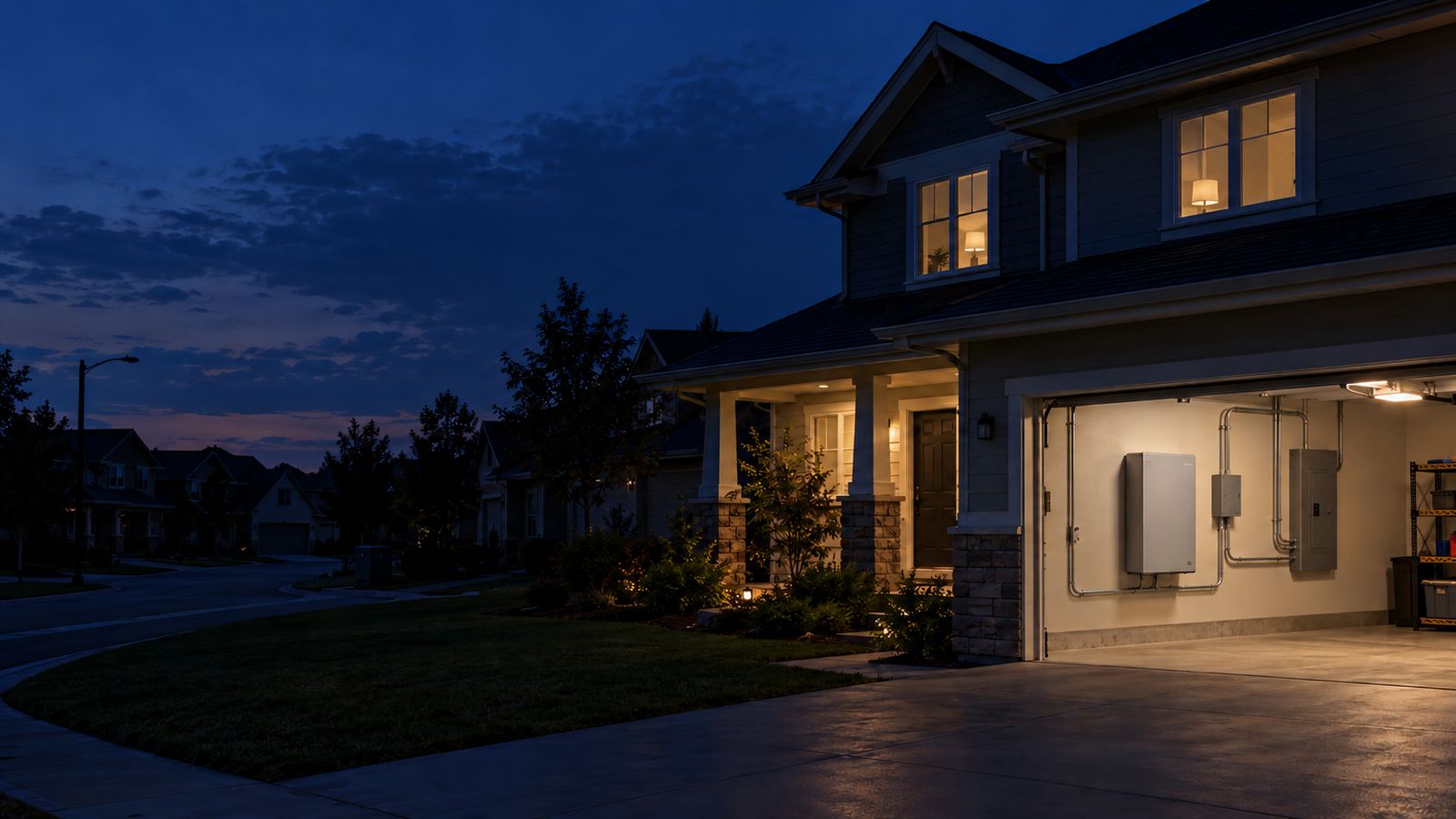
How long can a home battery power a house during an outage? It can be anywhere from a few hours to several days. The answer depends on what you ask the battery to run, not just how big it is.
When the power goes out, most people don't think in kilowatt-hours. They want to know simple things. Will the fridge stay cold? Will the lights and Wi-Fi stay on? Can the battery run the air conditioner? This guide walks through how to answer those questions for your own home.
What Decides How Long a Home Battery Lasts?
Four things matter most:
- How much usable energy the battery stores.
- How much electricity your home uses while the grid is down.
- Which circuits and appliances the battery is set up to power.
- Whether solar panels can recharge the battery during the outage.
So the best way to judge a battery is by what you want it to do in an outage. Size alone doesn't tell you much.
The Simple Battery Backup Math
Battery storage is measured in kilowatt-hours (kWh), the same unit on your electric bill. Your home uses power at a certain rate, measured in kilowatts (kW). To estimate backup time, use this rule of thumb:
Battery capacity ÷ average power use = approximate hours of backup
Here is an example with about 10 kWh of usable storage:
- 0.5 kW average use: about 20 hours
- 1 kW: about 10 hours
- 2 kW: about 5 hours
- 4 kW: about 2.5 hours
- 5 kW: about 2 hours
Real results will be a bit lower. Batteries lose some energy in use, and many keep a reserve that you can't drain. Your home's power use also changes from hour to hour. But the main idea holds: the more power you use, the faster the battery runs out.
What Can a Home Battery Keep Running?
In an outage, most homes don't need every circuit working like normal. They need the essentials, such as:
- Refrigerator and freezer
- Internet modem and Wi-Fi router
- A few lights and outlets
- Phone and laptop charging
- Fans, TV and the garage door opener
- Security systems
- Medical equipment
These are fairly small loads, so a battery can often run them far longer than it could run a whole house. The circuits you choose to keep on are called your critical loads. They are one of the biggest factors in what size and type of backup system you need.
If someone in your home depends on powered medical equipment, plan with your doctor and your utility too. A battery should be one part of that plan, not the only part.
Your Refrigerator Is Usually Not the Problem
Food is often the first worry in an outage. The good news is that a refrigerator uses fairly little power compared with heating and cooling equipment. It also doesn't run nonstop. The compressor turns on and off as needed. Bigger refrigerators do use more power than smaller ones.
The heavy users are things like:
- Central air conditioning
- Electric heat
- Electric water heaters
- Clothes dryers and electric ovens
- Electric vehicle (EV) charging
Keeping the fridge cold, a few lights on and the internet working is a very different job from running the whole home normally.
Can a Home Battery Run Your Air Conditioner?
In hot places like Florida, Texas and Arizona, staying cool in a summer outage can matter more than anything else. But central air conditioning is one of the largest loads in most homes. While it runs, it can use several kilowatts. That can cut battery time sharply.
Here is a hypothetical example. A home running only essentials might average about 500 watts (0.5 kW). A 10 kWh battery could run that for close to 20 hours. Turn on the AC and push average use to 4 kW, and the same battery lasts only about 2.5 hours.
So "Can it run the AC?" isn't quite the right question. Better questions are:
- Can the battery system start the AC compressor?
- How much power does the AC use while it runs, and how often does it cycle?
- How big is the battery?
- Can solar recharge it during the day?
- Will other large appliances run at the same time?
Starting Power Matters Too
Stored energy isn't the only limit. A battery system can only deliver so much power at one moment.
- kWh tells you how much energy is stored.
- kW tells you how much power the system can deliver at once.
Motors and compressors need a burst of extra power to start. A battery might hold plenty of energy but still not deliver that burst. This matters most for central air conditioners, well pumps, pool pumps and other motor-driven equipment. A good backup design checks both numbers: energy and power.
Critical-Load Backup vs. Whole-Home Backup
You'll often hear two types of battery backup. They are not the same.
Critical-load backup powers only selected circuits during an outage. That might be the fridge, kitchen outlets, internet, a few lights, one bedroom and medical equipment. The goal isn't to live normally. It's to keep what matters most running until the grid comes back. Because fewer things run, the battery lasts much longer.
Whole-home backup keeps much more of the house available. Even then, you may not want to run the central AC, dryer, oven, EV charger, pool equipment and electric water heater all at once. Whole-home backup adds comfort, but large loads can require much more battery storage and more power output.
One Battery vs. Multiple Batteries
Adding battery storage generally adds backup time. Many single home batteries store roughly 10 to 15 kWh of usable energy, though sizes vary. Many systems also let you add more batteries.
These simple examples leave out real-world losses and reserves, but they show the idea:
- 10 kWh: about 20 hours at 0.5 kW, 5 hours at 2 kW, or 2.5 hours at 4 kW
- 20 kWh: about 40 hours at 0.5 kW, 10 hours at 2 kW, or 5 hours at 4 kW
- 30 kWh: about 60 hours at 0.5 kW, 15 hours at 2 kW, or 7.5 hours at 4 kW
Doubling your storage roughly doubles your stored energy. That doesn't mean everyone needs several batteries. It means the system should be sized around your real backup goal.
How Solar Changes Battery Backup During an Outage
A battery on its own holds a set amount of energy. Once it's empty, it stays empty until it can recharge.
Solar can change that. On their own, most grid-tied solar systems shut off during an outage for safety. But a solar-plus-battery system can be designed to disconnect from the grid and keep powering your home. Then the question changes. It's no longer "How long will this battery last?" It becomes "Can my solar make enough power each day to replace what I use?"
Picture a battery that runs the fridge, lights, fans and internet overnight. The next morning, the solar panels start producing. Solar can then:
- Power the house during the day.
- Recharge the battery.
- Get the battery ready for another night.
In good conditions, that daily cycle can stretch backup time a lot. Results still vary widely from home to home. Power use, solar production, weather and the time of year all play a part.
What Happens During a Multi-Day Outage?
Hurricanes, ice storms, wildfires and equipment failures can knock out power for days. In a long outage, it helps to switch into conservation mode. That can mean:
- Setting the thermostat a few degrees higher, or cooling only part of the home
- Using fans when you can
- Skipping the dryer, oven and dishwasher
- Not charging an EV and turning off pool equipment
- Turning off lights you don't need
- Charging devices in daylight while solar is producing
A household that manages its power carefully can stretch the same battery much longer than one trying to live normally.
Could a Battery Keep the AC Running Overnight?
Possibly, but it has to be worked out for your home. Here are two hypothetical examples:
- If the AC and essentials average 3 kW for 8 hours, that's 3 × 8 = 24 kWh.
- If the AC cycles less and the average drops to 1.5 kW, 8 hours takes about 12 kWh.
That's a big difference in battery size. Home size, insulation, outdoor temperature, thermostat settings, AC efficiency and daily habits all affect the answer.
Batteries Aren't Just About Runtime
Backup time matters, but so does what you're protecting. A battery can help keep refrigeration, communications, home security, medical equipment, lighting, well pumps, temperature control and remote work going. Backup power during outages is one of the main reasons homeowners consider battery storage. That makes sizing less about buying the biggest battery and more about defining your goal.
How Much Battery Backup Does Your Home Need?
Start with four questions:
- What must stay powered? List the circuits you can't do without.
- What would you like to keep powered? Separate comfort from need.
- How long do you want to go without the grid? Planning for three hours is different from planning for three days.
- Will solar recharge the battery during an outage? This can change how much storage you need.
Once you answer these, battery storage can be sized around your real goal.
So, How Long Can a Home Battery Power Your House?
There is no single answer. A battery might last:
- Only a few hours if it runs central AC and other large appliances.
- Most of a day with moderate household use.
- A day or longer on carefully chosen critical circuits.
- Much longer with enough solar to recharge it and careful power use.
The battery is only half of the equation. What you choose to power decides how long the stored energy lasts.
The Ashborn Approach
At Ashborn Partners, we don't start by asking how many batteries fit on your house. We ask what you want your house to do when the grid goes down. Keeping food cold, the internet on and phones charged needs a very different system than whole-home cooling, a well pump or multi-day backup. An Advisor looks at your goals, your home's electrical loads, your heating and cooling equipment, your utility, your solar potential and your outage concerns. Then you can see whether a battery makes sense, and how much storage is actually worth it, through participating providers serving your area.
The goal isn't the biggest battery. It's enough backup for the things that matter.
Backup times in this guide are simplified, hypothetical examples. Actual runtime depends on battery size and settings, equipment, weather, household use and solar production. Battery products, features and incentives vary by provider and location.